Debt consolidation for Alberta Homeowners
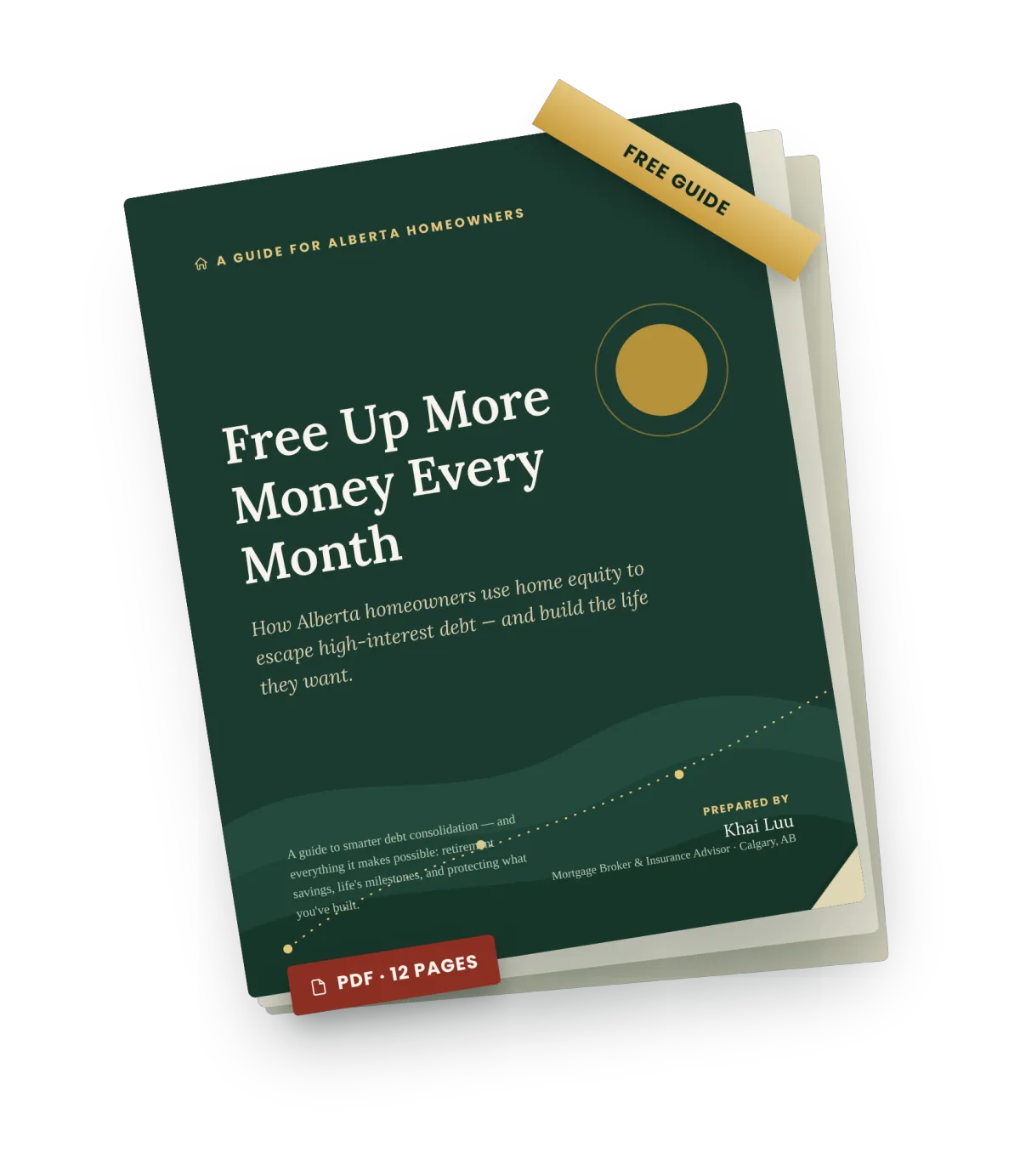
A Free Guide for Alberta Homeowners
How Alberta Homeowners Use Home Equity to Escape High-Interest Debt and Build the Life They Want
Stop Paying High Interest Every Month & Start Building the Life You Actually Want
If you're a homeowner carrying credit card debt, a line of credit, or other high-interest balances, the equity in your home could free up hundreds of dollars a month — money you could put toward retirement, your next family trip, or protecting what you've built. This free guide shows you exactly how.
$3M+
Debt consolidated
$800+
Average Monthly Saving
50+
5-star reviews
A Free Guide for Alberta Homeowners
Stop Paying High Interest Every Month & Start Building the Life You Actually Want
Subscribe to Get the Guide in Your Inbox
Join the newsletter and you'll get instant access to Free Up More Money Every Month — plus occasional, genuinely useful emails on saving money, managing debt, and making the most of homeownership in Alberta. No fluff, and you can unsubscribe anytime.
Your information is kept private and will never be sold. We send helpful, occasional emails — not a flood of them — and you can unsubscribe with one click, anytime.
The Problem
Every Month, Your Interest Payments Are Winning
You check your balance. You made every payment on time. And somehow, the number barely moved. That's not in your head. On high-interest debt, most of what you pay every month never touches what you actually owe — it just covers the interest. You're working, paying, and sacrificing, and the debt is still there, almost untouched, like it's laughing at you.
It shows up in small ways you don't even talk about:
>>> Saying "maybe next year" to the family trip — again.
>>> Watching your retirement savings go untouched month after month, while you tell yourself you'll "catch up later".
>>> The quiet dread of checking your credit card balance before you check your bank account.
>>> Turning down plans, or saying yes and feeling sick about it after.
>>> Lying awake doing the math on payments that never seem to add up in your favor.
>>> Feeling behind compared to people who, as far as you can tell, aren't dealing with any of this
And underneath it, a harder question: if something happened to you tomorrow — a job loss, a health scare — would your family actually be okay? For a lot of homeowners, the honest answer is "I don't know," and that's a heavy thing to carry quietly.
None of this is because you did something wrong. Life happens — rates went up, expenses piled on faster than income did, an emergency landed at the worst time. But knowing it's not your fault doesn't make the treadmill any less exhausting. Every month you stay on it is a month of interest paid, and a month further from retirement, from a vacation, from actually feeling secure.
Here's the thing most homeowners don't realize: the equity you've built in your home might already be the way off that treadmill.
Think You Can't Qualify? You Might Be Surprised.
Bruised credit
Whether it's from a rough patch, a medical emergency, a business setback, or a few missed payments during a tough year, a lower credit score can make traditional banks say no — even if your financial situation has since stabilized. Banks tend to look at the score as the whole story. Alternative lenders take a broader view: they can look at your income, your equity, and your current ability to pay, not just a number that reflects your past. Debt consolidation through an alternative lender can roll your higher-interest balances into one manageable payment secured against your home — and consistently paying down consolidated debt over time can also help rebuild your credit.
Non traditional income
If you're self-employed, you already know the bank's playbook: they want two-plus years of tax returns showing steady, provable income — which doesn't reflect how a lot of small business or contract income actually works (write-offs, seasonal swings, income that looks lower on paper than what actually comes in). This often disqualifies otherwise financially healthy business owners from traditional lending. Alternative lenders offer options like stated-income or bank-statement programs that assess your real cash flow rather than only your net income line. This can open the door to consolidating debt and freeing up monthly cash flow — even when a bank's paperwork requirements say no.
Consumer proposal
A consumer proposal shows up on your credit report and is typically an automatic decline at most banks, even once you're actively paying it off in good standing. But being in a proposal doesn't necessarily mean you have no equity or no ability to manage a consolidated payment. Some alternative lenders will consider your file based on your equity position and your track record of payments within the proposal, rather than treating the proposal itself as disqualifying. Depending on your situation, this may create a path to consolidate remaining debt, simplify your payments, and get ahead of your financial reset instead of just waiting it out.
Arrear income / property tax
Falling behind on income tax or property tax happens — a slow season, an unexpected expense, an underestimated tax bill. But tax arrears are a red flag for most banks, sometimes enough on their own to trigger a decline, even when the rest of your finances are otherwise solid. Alternative lenders are often more willing to work with homeowners in this position, structuring a consolidation that pays out the arrears directly and rolls them into a single, manageable payment — helping you avoid penalties, interest, or collection action from CRA or your municipality while getting your finances back on stable footing.
The complete guide to debt consolidation for Alberta homeowners will help you evaluate your situation and see if debt consolidation through the use of your home equity is appropriate for you. Click below to subscribe to our newsletter and get the free guide delivered straight to your inbox.
The Solution
One Guide. A Clear Path Forward.
Free Up More Money Every Month walks you through exactly how Alberta homeowners are using their home equity to consolidate high-interest debt into one lower, manageable payment — and what to do with the extra cash flow that creates. It's not a sales brochure — it's the same framework I walk clients through, written so you can work through it on your own first.
Understanding what your debt is costing you
Most people have never actually seen the number: how much of every payment is going to interest versus paying down what they owe. The guide breaks this down with a simple, real example, so you can see the gap between what you're paying now and what you could be paying — in plain dollars, not bank jargon.
Understand your options, side by side
Refinance. HELOC. Second mortgage. They all use your home equity, but they work differently — different rates, different flexibility, different long-term costs. Instead of guessing which one applies to you, the guide lays out how each works and what to weigh before choosing.
Know what actually happens, step by step
A lot of homeowners hesitate simply because the process feels like a black box. The guide walks through what really happens from the first conversation through to closing — what we review together, what you'll need to provide, and what to expect at each stage — so there are no surprises.
See where the freed-up money can go
This is the part most guides skip. Once your payment drops, that extra room in your budget doesn't have to just disappear into daily spending — it can go toward retirement savings, an emergency fund, a family trip, or insurance that protects what you've built. The guide walks through how to think about that decision, not just the mechanics of consolidating.
Inside the guide, you'll also find
>>> A simple checklist to see if debt consolidation is the right move for you right now
>>> What to know if you have bruised credit, self-employment income, a consumer proposal, or tax arrears — situations that often get an automatic "no" from a bank
>>> Straight answers to the questions every homeowner asks: will this hurt my credit, how much can I borrow, what does it cost, and how do I avoid re-accumulating debt after consolidating

Meet The Broker
My name is Khai.
Hi, I'm Khai Luu — a Calgary-based mortgage broker and insurance advisor. I've put together this guide because I see the same story again and again: hard-working homeowners stuck paying high interest every month, not realizing the equity in their home could change that. No sales pitch, no pressure — just clear, practical information so you can make an informed decision about your own finances.
By the end of this guide, you'll know:
✓ Whether debt consolidation through your home equity makes sense for you
✓ What the real numbers and trade-offs look like
✓ What to do with the money you free up each month
✓ Exactly what to expect if you decide to move forward
Our Results Speak for Themselves
Clients' success stories
Unlike most accounting companies, Precision Tax is an integrated finance management team. We see ourselves as your partner, Not as a Client - Firm Relationship

Over $2,000 CAD saved a month after consolidating her debts.
We have had an exceptional experience working with Khai, and we are extremely satisfied with the level of service provided.
PING. G

Over $1,500 CAD saved a month.
We were pleasantly surprised by their exceptional expertise and professionalism, surpassing our expectations.
JOHN R.

Over $1,200 CAD saved a month.
With Khai's help, we were able to pay off our high interest loans and set our finance for greater future success
LISA. M

Over $1,700 CAD saved a month.
Working with Khai has completely transformed our finance, making a significant impact on our peace of mind.
XUAN. K
Who's This Perfect For
Homeowners
high interest debts
35% or more in equity
tight cashflow
Value long-term finance
bank says no
arrear in taxes
non traditional income
bruised credit
STILL NOT SURE?
Frequently Asked Questions
Quick Questions Before You subscribe?
Question 1: Is this actually free?
Yes — completely free, no strings attached. Subscribing gets you instant access to the guide, plus future emails you can unsubscribe from anytime.
Question 2: Will you spam me or hound me with sales calls?
No. You'll get the guide by email right away, and after that just occasional, genuinely useful tips — nothing pushy, and no phone calls out of the blue. If it's ever not useful to you, you can unsubscribe in one click.
Question 3: Do I have to stay subscribed to keep the guide?
No — once it lands in your inbox, it's yours. You're welcome to unsubscribe from future emails right away if you'd prefer just the guide.
Question 4: I don't have great credit / I'm self-employed / I'm in a consumer proposal — is this still worth reading?
Especially then. The guide covers exactly these situations and what alternative lending options may look like for you.
Question 5: Do I have to work with you after reading it?
Not at all. There's no obligation. If it's helpful and you want to talk through your specific situation afterward, I'm happy to chat — but that's entirely up to you.
Question 6: Why are your giving out for free, what's the catch?
There is no catch. Giving you this free guide is just a way for me to lead with value. I want to provide so much value to you so that whenever you need the service, I hope through the value I provide you, I can be your first choice.
Question 7: I'm not ready to do anything, I'm just exploring. Should I still get the guide?
Kudo to you for exploring your options early. I want to assure you that you do not have do do anything else beside subscribing to my newsletter. As soon as you do, the guide will be send you your inbox. If you see value in the information I'm providing, stay subscribed. If not, you can unsubscribe with one click.
Stop letting high interest quietly eat into your pay cheque every month.
Subscribe and get the free guide sent straight to your inbox.
© 2026. Khai Luu Mortgage & Financial Services. All rights reserved.